
The first arrangement a practice puts in place is rarely the one it ends up keeping. Workflows get adjusted as both sides learn how the other works, and the type of work handed over tends to change once confidence builds. Pricing is often the part that needs rethinking most. In Deloitte’s 2024 Global Outsourcing Survey of more than 500 business leaders worldwide, 70% had brought some outsourced work back in-house over the previous five years, and more than half of them cited the need to manage spend.
This guide compares the three main ways outsourcing providers charge for their work, where each one works well and where it can cost more than expected, so you can match fixed fee accounting outsourcing, hourly support and dedicated staff to the work that suits each one best.
How accounting outsourcing pricing models affect your costs
What practices expect to pay
Most practices come to outsourcing expecting it to cost less than hiring locally, and the numbers explain why. In the US, the median annual wage for accountants and auditors was $83,680 in May 2025. Offshore staffing platform MAVI puts the cost of accountants in India and the Philippines at 50 to 70% less than equivalent US hires, and in Latin America at 50 to 65% less.
Those differences shape the rates providers quote, so practices often judge accounting outsourcing costs on the headline price alone. A lower rate does not always produce a lower cost per job, though. The final cost also depends on how the work is priced, how much review it needs when it comes back and how many queries it generates along the way.
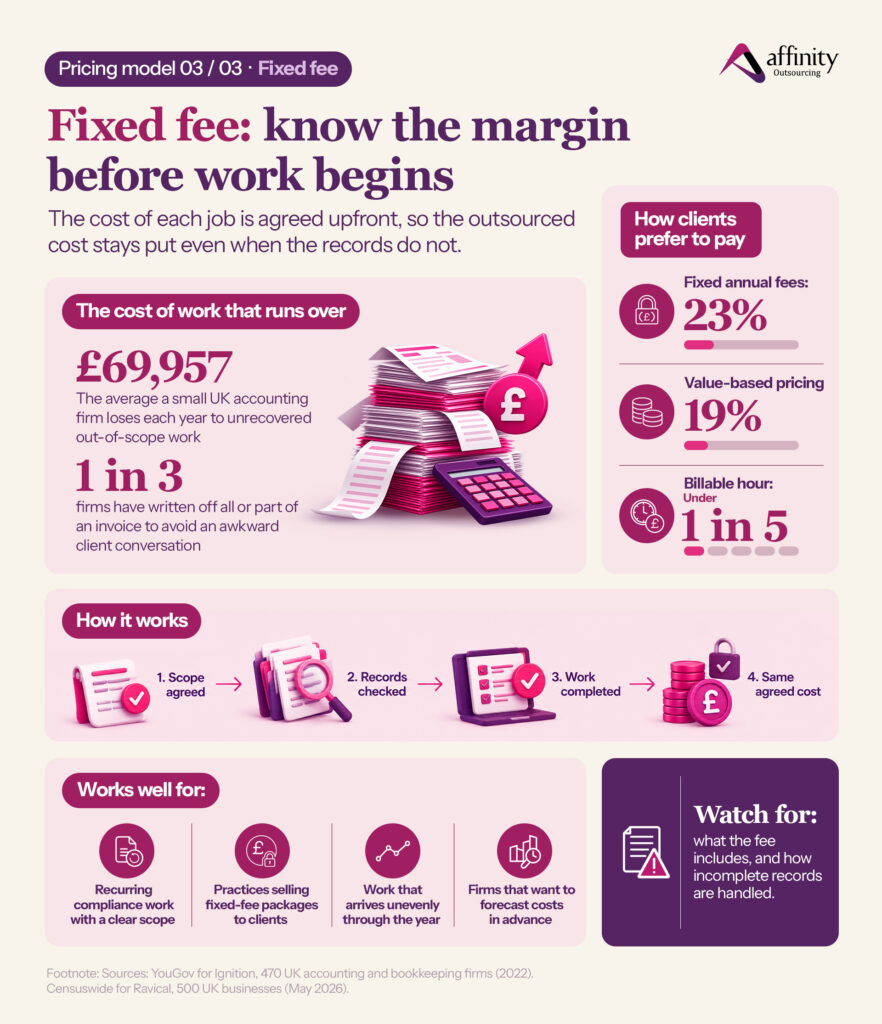
The other side of the sum matters too. A Censuswide survey of 500 UK businesses for Ravical found clients’ preferences split across fixed annual fees (23%), value-based pricing (19%) and the billable hour. With practices charging clients in different ways, the way they pay for outsourced work needs to fit each type of work.
Where the margin slips
- a job quoted to the client at a fixed fee is outsourced on a cost that varies with the state of the records
- a dedicated resource costs the same in quiet months as in busy ones, while client fees arrive unevenly
- small overruns go unrecovered because the client fee has already been agreed
None of these models is flawed in itself. The trouble starts when the model doesn’t fit the work, and the arrangement gets written off as not working when the real issue was how it was priced.
Many practices already struggle to recover overruns on their own client work. YouGov research for Ignition found that small UK accounting firms lose an average of £69,957 a year to unrecovered out-of-scope work, and one in three had written off all or part of an invoice to avoid an awkward client conversation. An outsourcing cost that doesn’t match the client fee adds a second layer of that risk.
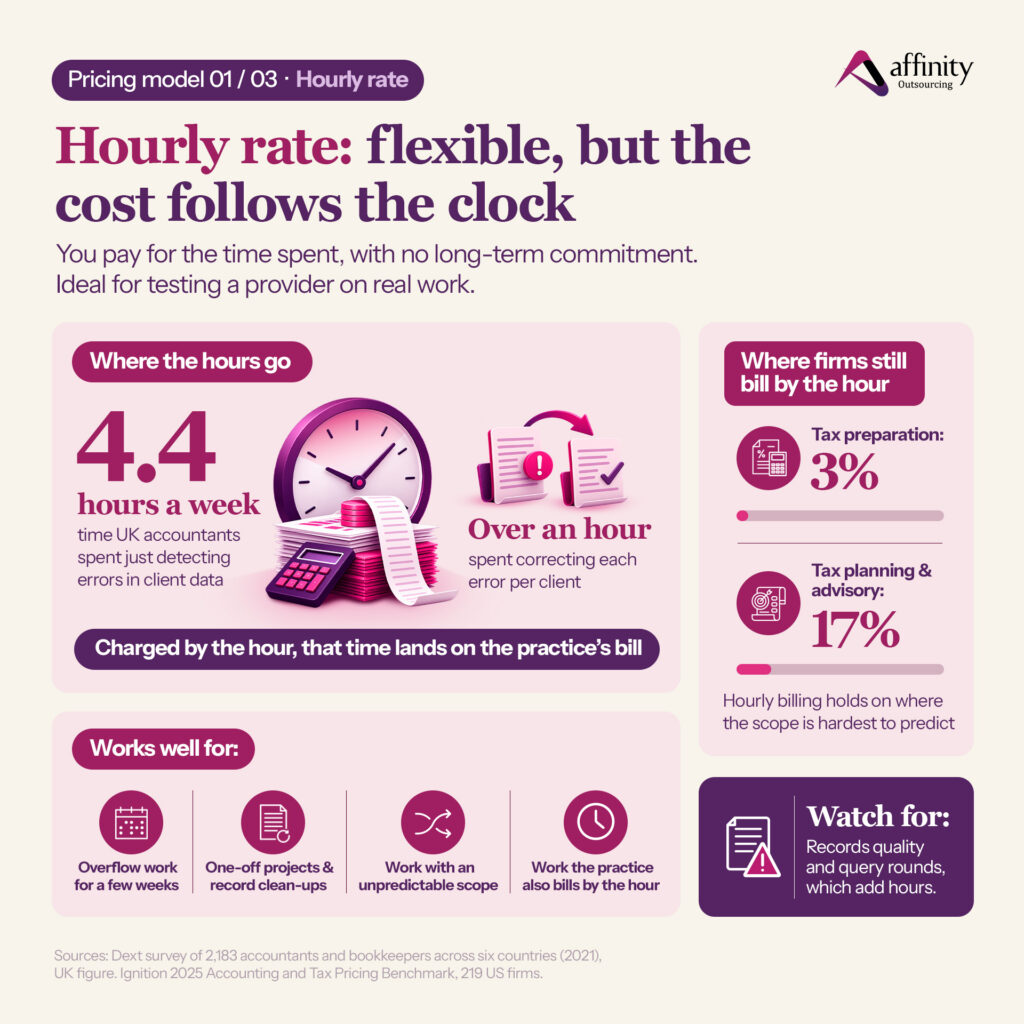
Hourly rate accounting outsourcing: flexible, but the cost follows the clock
Where hourly works well
- Overflow work, when the practice needs extra hands for a few weeks rather than ongoing capacity
- One-off projects, such as catching up on backlogged bookkeeping or cleaning up a client’s records before year end
- Work with an unpredictable scope, where neither side can reasonably estimate the time in advance
- Work the practice also bills by the hour, so the outsourcing cost rises and falls in line with the client fee
Where the cost can climb
To take a simple, hypothetical example, a practice might charge its client a fixed fee for a set of sole trader accounts and expect the outsourced preparation to take eight hours. If disorganised records stretch that to fourteen hours, the outsourcing cost rises by three quarters while the client fee stays exactly where it was.
Get monthly accounting tips and updates - straight to your inbox
Join our email list to access expert insights, company updates, and practical advice.
Dedicated accounting staff for accounting practices: steady capacity at a fixed monthly cost
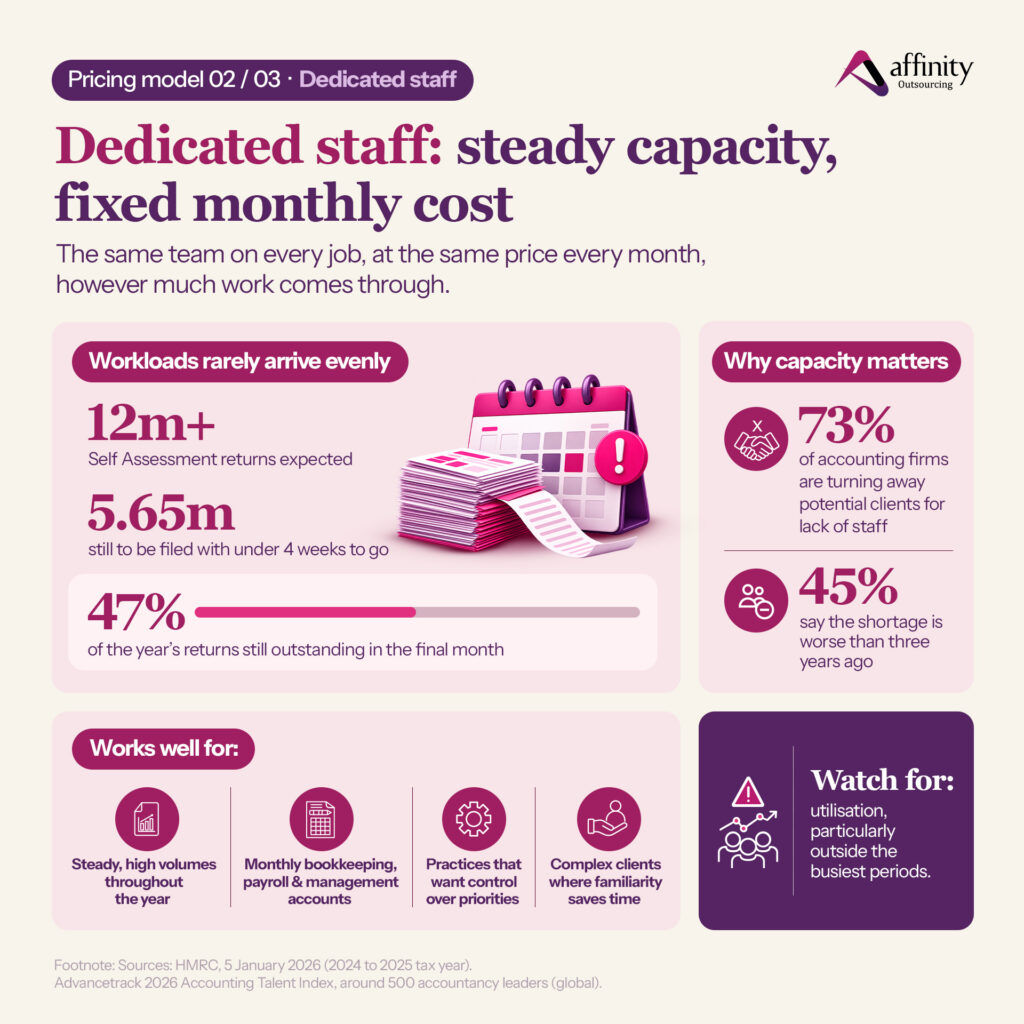
Where a dedicated model works well
- Steady, high volumes throughout the year, where the resource can be kept fully occupied
- Recurring work for the same clients, such as monthly bookkeeping, payroll and management accounts
- Practices that want control over priorities, as the team can be redirected without renegotiating fees
- Complex or specialist clients, where familiarity with the client’s history saves time on every job
Where the cost can climb
In quieter months, the practice pays for capacity it does not fully use, which pushes up the effective cost of every job. In the busiest weeks, a single dedicated resource may not be enough, so the practice pays for extra support on top of the monthly fee. As a hypothetical example, a resource that completes forty jobs in a busy month and fifteen in a quiet one costs the same in both, so the cost per job in the quiet month is more than two and a half times higher.
Fixed fee accounting outsourcing: knowing the margin before work begins
Where a fixed fee works well
- Recurring compliance work with a clear scope, such as year-end accounts, Self Assessment returns, VAT returns and corporation tax computations
- Practices that sell fixed-fee packages to their own clients, so the pricing works the same way on both sides
- Work that arrives unevenly through the year, as the practice pays per job rather than for capacity it may not use
- Firms that want to forecast, since the cost of a planned volume of work can be calculated in advance
Where to look closely
- exactly what is included in the fee for each type of job
- how incomplete or disorganised records are handled, and whether they change the price
- what would cause the fee to be revisited
- whether the records are checked before work begins
The last point matters more than it might appear. A provider that reviews the records at the start will raise missing information while the practice can still go back to its client, rather than discovering the gaps once the work is under way.
Fixed fee vs hourly rate outsourcing: choosing the right model
| Hourly rate | Dedicated staff | Fixed fee | |
| How it is charged | By the time spent on each job | A set monthly fee for one or more people | An agreed price per job, set before work begins |
| Best suited to | Overflow, one-off projects and work with an unpredictable scope | Steady, high volumes of recurring work throughout the year | Recurring compliance work with a clear scope |
| Cost predictability | Low, as the cost depends on how long each job takes | High per month, but the cost per job varies with volume | High, as the cost of each job is known in advance |
| Who carries the overrun risk | The practice | The practice, through unused capacity in quieter months | The provider, within the agreed scope |
| Flexibility | High, with usually no long-term commitment | Lower, as the resource is committed for an agreed period | High, as the practice pays only for the jobs it sends |
| Points to watch | Records quality and query rounds, which add hours | Utilisation, particularly outside the busiest periods | What the fee includes and how incomplete records are handled |
Many practices find that a mix works better than any single model, such as fixed fees for recurring compliance, a dedicated resource for monthly bookkeeping and payroll, and hourly support for one-off projects. The right combination often becomes clearer once an arrangement has been running for a while.
Find the right pricing model for your practice
Building an outsourcing process that lasts rarely happens on the first attempt, and the pricing model is often the part that needs the most adjustment along the way. Affinity Outsourcing offers all three models, so practices can start with the arrangement that fits their current workload and adjust it as their needs become clearer. Under the Affinity Outsourcing fixed-fee model, fees are set as a percentage of what the practice charges its own client, which keeps the profit on every job visible from the outset. You can see how each option works on our How we work page.
To talk through which model, or combination of models, would suit your practice, call 020 3965 3358, email info@affinityoutsourcing.net or schedule a consultation.


